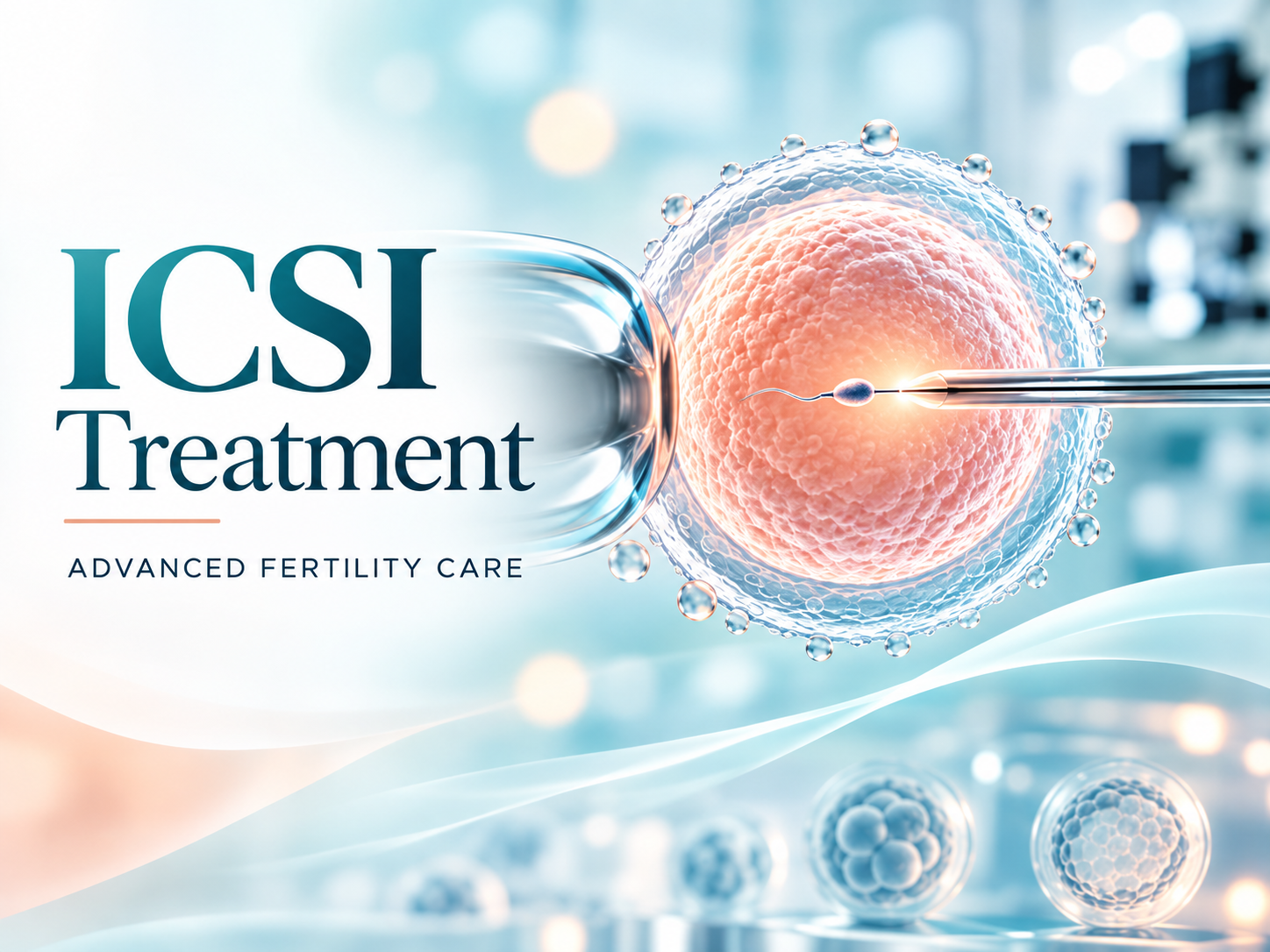
For couples facing challenges with fertility, particularly those linked to male infertility, Intracytoplasmic Sperm Injection (ICSI) can provide an advanced approach to assisted reproduction. ICSI is a specialised laboratory technique used as part of an IVF treatment cycle, in which a carefully selected single sperm is injected directly into a mature egg to assist fertilization.
Dr. Yuvraj Singh Jadeja provides personalized fertility care for couples exploring ICSI treatment in Vadodara, with treatment decisions based on the underlying cause of infertility rather than a one-size-fits-all approach.
What Is ICSI and When Is It Recommended?
Intracytoplasmic Sperm Injection, or ICSI, is an assisted fertilisation technique in which an embryologist injects a single sperm directly into the cytoplasm of a mature egg. It is most commonly performed as part of an IVF cycle when there is a concern that sperm may have difficulty fertilising the egg naturally in the laboratory.In conventional IVF, prepared sperm and mature eggs are placed together and fertilisation is allowed to occur without injecting sperm into the egg. With IVF with ICSI, the fertilisation stage is different: an embryologist selects an appropriate sperm and introduces it directly into the egg using a microscopic injection needle. This means that ICSI can bypass several barriers that may otherwise prevent sperm from reaching or penetrating the egg.
Who may benefit from ICSI treatment?
ICSI may be considered when fertility investigations identify a significant male-factor infertility component or when fertilisation has been difficult during a previous IVF cycle.
Common situations where ICSI may be recommended include:
Major fertility authorities recognise ICSI particularly for male-factor infertility, previous poor fertilisation and circumstances involving surgically retrieved sperm. However, ICSI is not automatically necessary for every patient undergoing IVF.
ICSI for male infertility.
One of the most important applications of ICSI treatment for male infertility is its ability to work with extremely small numbers of sperm. Under natural conditions, sperm must travel through the female reproductive tract, reach the egg and penetrate its outer layers before fertilisation can occur. Even during conventional IVF, sperm must retain sufficient movement and function to penetrate the egg.
ICSI bypasses this stage.
By placing a selected sperm directly inside a mature egg, the technique can help overcome fertilisation barriers associated with low sperm concentration, poor sperm movement and certain abnormalities in sperm morphology.This does not mean that every abnormal semen analysis automatically requires ICSI. Male fertility needs to be evaluated comprehensively. Semen parameters, medical history, reproductive history, hormonal factors, previous treatment outcomes and, when appropriate, additional investigations may all influence the treatment recommendation. For couples searching for an ICSI specialist in Vadodara, the important first step is therefore not simply choosing a procedure, it is determining why conception or fertilisation has been difficult in the first place.
ICSI and Azoospermia
ICSI has also expanded fertility options for certain men with azoospermia, a condition in which sperm are absent from the ejaculated semen. Depending on whether azoospermia is obstructive or related to impaired sperm production, sperm may sometimes be retrieved directly from the epididymis or testicular tissue. Techniques such as PESA, TESA, TESE or other sperm-retrieval procedures may be considered after appropriate evaluation. If viable sperm are successfully obtained, even a limited number may potentially be used for ICSI because only one selected sperm is required for injection into each mature egg. The exact treatment strategy should always depend on the cause of azoospermia and the couple's overall reproductive evaluation.